Cetinje, Old Mountain Capitol, 1400's;
Elegant, 1700's rebuilt
.
Cetinje Monastery
 Cetinje, Mongenegro, Monastery, Orthodox
Note the wheelchair for one of the worshippers, a young girl at services inside. Cetinje: To pronounce it, say the first C as a "ts." Say the J as a "y."
.
This is the old capital of Montenegro, with its historic monastery founded in 1484, rebuilt 1785. See
http://www.montenegro.org/mon_cet.
.
Behind it are cave-cliff areas, with the memorial to a person apparently shot by firing squad, that we now think is Jovan Plamenac, WWI and WWII patriot seeking independence for Montenegro, see post at
Montenegro Road Ways, Jovan Simonov Plamenac.
.
Shrines and caves are all around, and with young men coming and going in clusters, heads together. Was this because there was a vote coming up for independence or not, and people were being cautious in what they said around others. Also clusters of older men in overcoats, at the hotel and elsewhere, equally intent.
.
The monastery has had a variety of uses, while remaining a church. It housed the first schools, and once housed the manufacture of zinc cannon balls. See www.montenegro.org/mon_cet.
.
The area is rocky "karst" and the cliffs are riddled with tunnels and caves. Anyone hiding would be nearly impossible to find. See landscape photo at
http://www.visit-montenegro.org/english/kultura/msv_petar.
.
The monastery there is one of the oldest and most revered in Montenegro. Symbolic. See www.cetinje.cg.yu/engleski/istorija/cetinjski_man. People carried a young girl from the wheelchair there, into the service.
.
Religious rivalry. Christians East and West.
This has been intense between the Orthodox Christians and the Roman Catholic Christians has been part of the landscape for over a thousand years. At least.
.
There was a tragic culmination of it in the treatment of Orthodox in the Nazi era concentration camp at Jasenovac in Croatia, say the Orthodox, where Orthodox were killed while priests stood by, merely offering to convert the condemned to Catholicism before they were killed. Unrest by many who want to bring that issue into the open. See www.serbianna.com/columns/savich/063. See also
Croatia Road Ways post: Jasenovac.
.
Roots of people's divisions - subterranean, bursting. Who to believe. Each believes self.
.
Attending the Orthodox service:
.
Stand in the back for a 10AM chanted service. People came and went during it. We stayed for nearly an hour. More about the monastery at
http://www.barakatravel.com/?action=galeria&galeriaId=36. Many young men were there, and entire families, and this was on a non-holiday weekday. Many of the young men gathered behind, at the memorial.
.
The wheelchair: the monastery bells rang for the morning service, and a young girl, perhaps with cerebral palsy, was carried-helpwalked to it. There is her wheelchair. The church was full, but many people came and went, some stayed as we did. Standing. Relics are here, in the museum attached, with many guards.
 Cetinje, Montenegro, Orthodox Monastery facade
Read the history of the monastery at
http://forum.verujem.org/index.php?topic=8068.0/ This presents its story from the point of view of piety, tradition, the meaning of the place and its suffering.
Few websites convey the religious depth of a monastery like this one. Take time to read this one. It sounds like one of the monks wrote it. Salute the reverence, the relics. Live the razing by the Turks, the rebuilding, the importance of foundations.
.
The monastery is the center of the universe for the monk, is written. It is Serbian Orthodox, and many Russian pilgrims come. See
http://www.spc.rs/Vesti-2006/06/05-06-06-e.html/ In what ways do the various Orthodox churches differ? Need to find out.
.
The religious divisions in Montenegro show a strong majority of Orthodox: There are 74% Orthodox, 18% Muslim, 3.5% Roman Catholic, see US Embassy Religious Freedom Report 2008 at
http://podgorica.usembassy.gov/religious_report_2008.html/
.
Behind the monastery is this shrine, a martyr from a modern war, we think Jovan Plamenac. His life extended from WWI, WWII. He was killed by the French. There are fresh flowers, always the young men moving about. We kept at a distance. Other sites focus on the struggle for survival over the centuries, wars. See
http://www.yuta.rs/en/TRAVELGUIDE/MontenegroM.asp/
The area is full of caves, for living, hiding, munitions.
.
 Cetinje, Montenegro, cave area, behind monastery
.
Montenegro is now independent, as of 6/06.
.
Centuries of struggle here, and in all the Western Balkans. The area has been a crossroads for monolithic and violent movements in religion, empire, and just plain greed-treachery. Hard to put it all together; but clearly the mountainous terrain made foreign settlement difficult. See
http:////www.cetinje.cg.yu/engleski/istorija/istorija for History of Cetinje.
.
Can someone translate the shrine and email us so we can double check our identification as Plamenac?
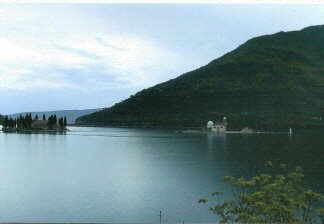 Kotor Bay, Montenegro, Our Lady of the Rock, Perast Islands; Island of St. George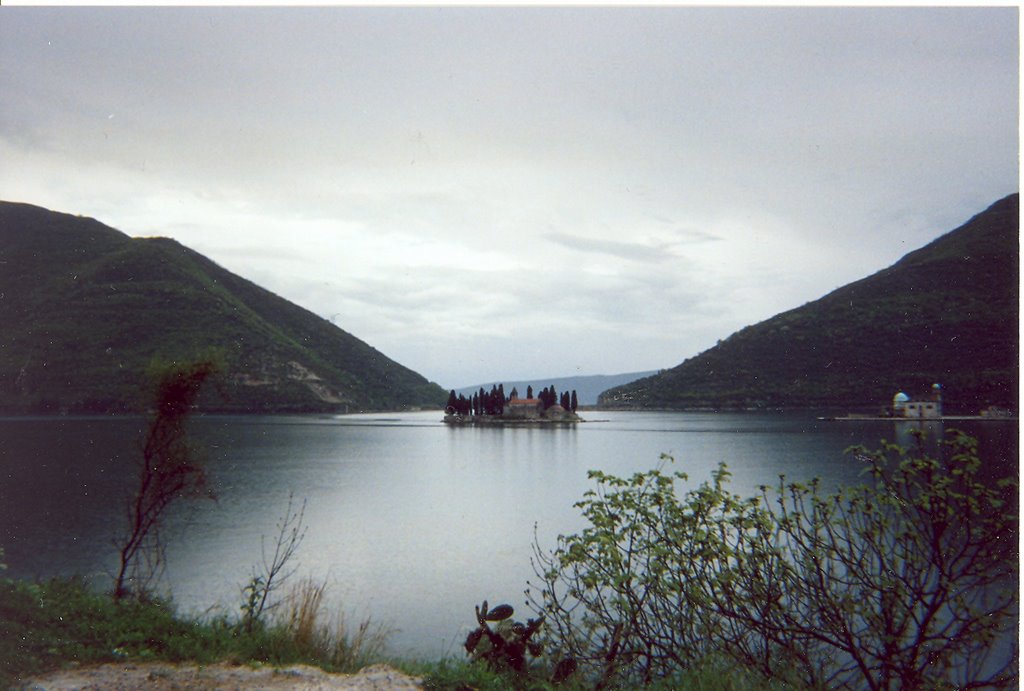


 Cetinje, Mongenegro, Monastery, Orthodox
 Cetinje, Montenegro, Orthodox Monastery facade
 Cetinje, Montenegro, cave area, behind monastery