Showing posts with label Cetinje. Show all posts

Sunday, January 04, 2009

Cetinje. Is This Jovan Simonov Plamenac? Cetinje Memorial, Monastery area. WWI, WWII, Leader. Strove for Independence, Montenegro

.
Cetinje
.
The Firing Squad Memorial
Is This Jovan Plamenac
Jovan S. Plamenac
.
.


Behind the monastery at Cetinje is this memorial of a man tied and apparently killed by firing squad. We think we have found his identity, finally, through Wikipedia, at http://en.wikipedia.org/wiki/Jovan_Plamenac/

See his biography at Ministers of Foreign Affairs, Princedom of Montenegro, Serb Land of Montenegro, History of Montenegro OnLine, at http://www.njegos.org/past/ministers.htm

Spellings from the Cyrillic alphabet and any foreign language into English produce many variations, so we will continue to look for his history.

This tentative identification has been years coming, and was found in front of our noses - Wikipedia. We were there in 2006.

Why the silence about him, an academic, a humanitarian? There is a splendid array of Cetinje photos in an online gallery at http://www.pbase.com/xerius/cetinje - see all the old embassy buildings - but even there no identification of the man at the stake here.
.
This does seem to be, from the background information given, Jovan Plamenac. Click on the photo caption and see the enlarged picture and read the caption in Cyrillic to check for us. Please.
.
Rough Biography of Jovan Plamenac, through WWI. We need to continue to WWII
.
1873-1944 - Information framework from Wikipedia, to be augmented as we learn more, here vastly condensed, giving gist only:
  • Montenegrin Serbian,
  • teacher,
  • Minister of Education,
  • Minister of the Interior, involved as such in the Balkan Wars,
  • berated King Nicholas for leaving the country WWI, 1916,
  • became Speaker of the Serbian National Assembly, Kingdom of Montenegro,
  • 1918 opposed unification of Serbia with Montenegro,
  • gathered armed forces to fight, Italian units repelled (here we get mixed with who were allies and who were axis in WWI in the Balkans, Italian as axis),
  • led the "Christmas Rebellion" at Cetinje against Italian forces, rallied peasants and others,
  • this time Allies including French defeated them,
  • guerrilla attacks went on for years,
  • Plamenac fled to Albania,
  • Nicholas in exile was critical of the insurgents, but appointed Plamenac to his government (alliances fluid during those times, apparently) in exile,
  • Plamenac continued to work for independence, against Serbian annexation,
  • League of Nations no help, none came,
  • blame for unrest fell on Italians and Plamenac,
  • Britain no help,
  • Plamenac wrote Woodrow Wilson,
  • and this goes on for more than we can learn now - have to go back to the WWII era
  • ultimately in WWII Plamenac apparently collaborated with the Nazis and was killed by firing squad, by the Allies
  • have to go back and read all that to see what happened. We are interested here: If the Allies were no help in Montenegrin independence from Serbia, and obtaining Montenegri independence were the life's work of a patriot, wouldn't a patriot go for help to the other side, regardless? Germans/Nazis were all over the Balkans - look at the Ustach government in neighboring Croatia. He was killed for collaborating with the Nazis? The Vatican collaborated also. See Croatian entries, Jasenovac death camp, Cardinal Stepinac, etc.
  • See Plamenac entry at http://en.wikipedia.org/wiki/Jovan_Plamenac.
Much more to be found out here - independence was achieved in 2006.
.
So: patriot, educated, cosmopolitan, sought independence.  The Axis Italians beat them back WWI, on the one side: Allied French beat them back when they tried again. 
.
WWII: Montenegro went with Germany that was occupying at the time in WWII, in this land that has been occupied by at least 8 nations in the last 1000 years, always occupied it; and the Allies kill him for collaborating.
.
There has to be more sense than that. Hold on.

Saturday, January 03, 2009

Cetinje - Monastery and caves.

Cetinje, Old Mountain Capitol, 1400's;
Elegant, 1700's rebuilt
.
Cetinje Monastery


Cetinje, Mongenegro, Monastery, Orthodox


Note the wheelchair for one of the worshippers, a young girl at services inside. Cetinje: To pronounce it, say the first C as a "ts." Say the J as a "y."
.
This is the old capital of Montenegro, with its historic monastery founded in 1484, rebuilt 1785. See http://www.montenegro.org/mon_cet.
.
Behind it are cave-cliff areas, with the memorial to a person apparently shot by firing squad, that we now think is Jovan Plamenac, WWI and WWII patriot seeking independence for Montenegro, see post at Montenegro Road Ways, Jovan Simonov Plamenac.
.
Shrines and caves are all around, and with young men coming and going in clusters, heads together. Was this because there was a vote coming up for independence or not, and people were being cautious in what they said around others. Also clusters of older men in overcoats, at the hotel and elsewhere, equally intent.
.
The monastery has had a variety of uses, while remaining a church. It housed the first schools, and once housed the manufacture of zinc cannon balls. See www.montenegro.org/mon_cet.
.
The area is rocky "karst" and the cliffs are riddled with tunnels and caves. Anyone hiding would be nearly impossible to find. See landscape photo at http://www.visit-montenegro.org/english/kultura/msv_petar.
.
The monastery there is one of the oldest and most revered in Montenegro. Symbolic. See www.cetinje.cg.yu/engleski/istorija/cetinjski_man. People carried a young girl from the wheelchair there, into the service.
.
Religious rivalry. Christians East and West.

This has been intense between the Orthodox Christians and the Roman Catholic Christians has been part of the landscape for over a thousand years. At least.
.
 There was a tragic culmination of it in the treatment of Orthodox in the Nazi era concentration camp at Jasenovac in Croatia, say the Orthodox, where Orthodox were killed while priests stood by, merely offering to convert the condemned to Catholicism before they were killed. Unrest by many who want to bring that issue into the open. See www.serbianna.com/columns/savich/063. See also Croatia Road Ways post: Jasenovac.
.
Roots of people's divisions - subterranean, bursting. Who to believe. Each believes self.
.
Attending the Orthodox service:
.
Stand in the back for a 10AM chanted service. People came and went during it. We stayed for nearly an hour. More about the monastery at http://www.barakatravel.com/?action=galeria&galeriaId=36. Many young men were there, and entire families, and this was on a non-holiday weekday.  Many of the young men gathered behind, at the memorial.
.
The wheelchair:  the monastery bells rang for the morning service, and a young girl, perhaps with cerebral palsy, was carried-helpwalked to it. There is her wheelchair. The church was full, but many people came and went, some stayed as we did. Standing. Relics are here, in the museum attached, with many guards.

Cetinje, Montenegro, Orthodox Monastery facade

Read the history of the monastery at http://forum.verujem.org/index.php?topic=8068.0/ This presents its story from the point of view of piety, tradition, the meaning of the place and its suffering.

Few websites convey the religious depth of a monastery like this one. Take time to read this one. It sounds like one of the monks wrote it. Salute the reverence, the relics.  Live the razing by the Turks, the rebuilding, the importance of foundations.
.
The monastery is the center of the universe for the monk, is written. It is Serbian Orthodox, and many Russian pilgrims come. See http://www.spc.rs/Vesti-2006/06/05-06-06-e.html/ In what ways do the various Orthodox churches differ? Need to find out.
.
The religious divisions in Montenegro show a strong majority of Orthodox: There are 74% Orthodox, 18% Muslim, 3.5% Roman Catholic, see US Embassy Religious Freedom Report 2008 at http://podgorica.usembassy.gov/religious_report_2008.html/
.
Behind the monastery is this shrine, a martyr from a modern war, we think Jovan Plamenac. His life extended from WWI, WWII.  He was killed by the French. There are fresh flowers, always the young men moving about. We kept at a distance. Other sites focus on the struggle for survival over the centuries, wars. See http://www.yuta.rs/en/TRAVELGUIDE/MontenegroM.asp/
The area is full of caves, for living, hiding, munitions.
.
Cetinje, Montenegro, cave area, behind monastery


This also would be an excellent geo-tourism site because of the geological sites and attractions, as we also suggest for Kotor Bay. See book "Geotourism" by Ross Dowling at this site: http://www.elsevier.com/wps/find/bookdescription.cws_home/706060/description#description.
.
Montenegro is now independent, as of 6/06.
.
Centuries of struggle here, and in all the Western Balkans. The area has been a crossroads for monolithic and violent movements in religion, empire, and just plain greed-treachery. Hard to put it all together; but clearly the mountainous terrain made foreign settlement difficult. See http:////www.cetinje.cg.yu/engleski/istorija/istorija for History of Cetinje.
.
Can someone translate the shrine and email us so we can double check our identification as Plamenac?

Tuesday, January 02, 2007

Cetinje, 500-year capital (until move to Podgorica)

Cetinje: Former Capital


Old Ruler Ivan Crnojevic, Hotel Grand

Cetinje, Ivan Crnojevic Statue, Monastery, Montenegro (Orthodox)


Here is Ivan Crnojevic, in the courtyard of the monastery at Cetinje.

He ruled 1465-1490, took on the Turks as well as the Venetians, and ultimately moved his capital here, to the now Cetinje.

This site says that marked the beginning of a more national consciousness for the Montenegrins. See more on Ivan Crnojevic at en.wikipedia.org/wiki/Zeta_%28state%29. Good for Wikipedia.


Cetinje, President's House, Montenegro


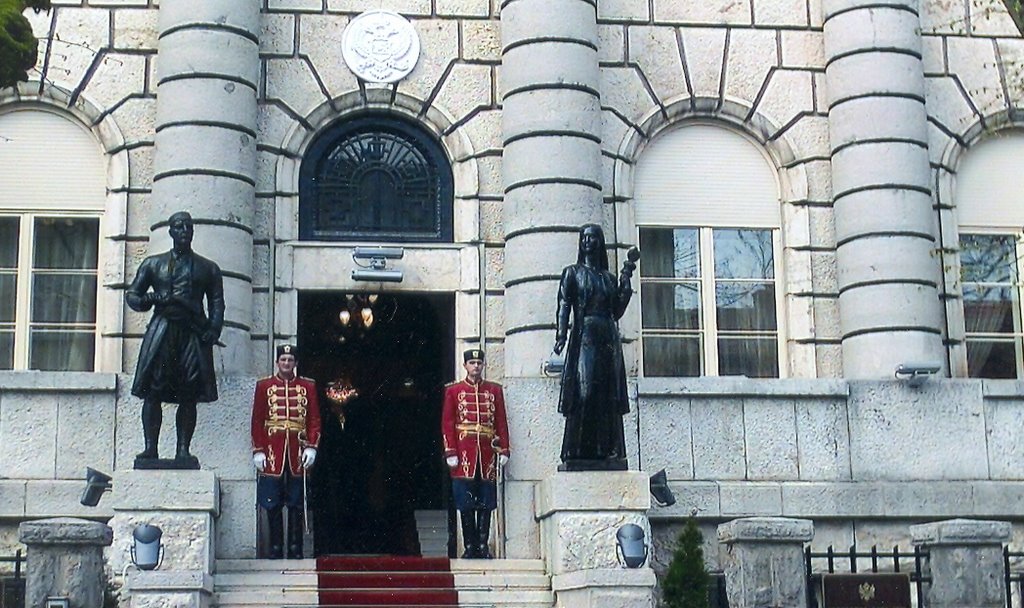
Cetinje was the capital for 500 years - with buildings showing many periods and styles, and many in disrepair after the move of the capital to Podgorica, a more accessible location. Cetinje is high in the mountains.

Here is the President's house. This would make a fine capital again.


Cetinje, Grand Hotel, Montenegro


This is the Grand Hotel, and I believe it is the only hotel. We saw no others. See www.cetinje.cg.yu/engleski/turizam/grand.

If there had been no hotel at all, we would have headed for one of the many schools' dorms to try to get a room, or introduced ourselves to the local police and slept in the car behind the police station.

That is the game plan, never had to use it. The area values education highly, and many of the old embassies from the glory days are schools. Before 1918, this was a political and educational hub. See www.montenegro.org/cetinje.

Choice to go on to the next town? Not up here. Rule: Avoid unfamiliar or any mountains after sunset. See www.cetinje.cg.yu/engleski/turizam/turizam. That site has links to the area's history, economy, attractions also. Wander there.

The hotel. Hotel Grand. This was built in 1984, see ://hotel-grand.tripod.com/It really looked like we were the hotel's only tourist visitors. There were clumps of men in suits, always in corners, talking. Secrecy. This was the month before the independence vote. Connection?

The heat arrived, everyone courteous, no inconvenience at all. The concierge had someone bring us in a heater, and the hot water came on by morning, so we were fine. Any big place has to conserve on utilities, and the food was good and the staff helpful. No complaints at all. It is reasonably kept up.

See the new government forming at www.bloomberg.com/apps/news?pid=20601085&sid=aQdBXJG9o5XY&refer=europe/ Montenegro New Prime Minister. Tensions were obvious when we were there May 2006, with a waiter telling us he could not really talk, groups hovering about, and so we took our photos quietly. The smooth transition in the news is welcome news.

Another fine photo gallery for Cetinje - see ://www.montenegro.com/phototrips/central/Cetinje,_the_old_capital.html/

Cetinje - Guides: Kids Anywhere

Soccer and Logo Clothing

Cetinje, Montenegro, Schoolboys


Our thanks to these fine gentlemen who stopped their soccer to give us some tips on the town and where the hotel was. Soccer news at www.einnews.com/serbiamontenegro/newsfeed-serbia-montenegro-soccer.

As I recall, each fellow has on an American logo shirt.

They also showed us the bunkers they had built (their words). These were cardboard constructs, and then one up a tree, like we do.

The difference is, their experience is direct. War has been in their back yard.

They knew good English, especially the scholar in the Gap shirt. I wrote the school administrator to find their addresses and send each of them this picture, and the US consulate, but no response.

Children - soccer is everywhere. Read more soccer news. With independence, Montenegro and Serbia probably will no longer share the same team. See www.topix.net/soccer-fifa/serbia-and-montenegro.

Expect the exotic and find just fine regular people. Same the world over.

Flag. If I were teaching with those boys in the class, I think they would like this website, for flags of the world, because they were so proud of their beautiful city. Go to www.allstates-flag.com/fotw/flags/cs-cg..

"I hope you like our beautiful city," said one boy as we left. The city is no longer beautiful in the way we think, because it is badly in need of repair, everywhere. But it is beautiful in what it evokes, and the treasure it clearly remains for Montenegrins.